
A Colombia advisory can look alarming when read as a single headline. The country is large, its security picture changes considerably from one department to another, and the places most independent travelers visit are not necessarily the places driving the warning. This latest travel advisory for Colombia explained guide puts the language into practical context, so you can decide what it means for your own route rather than canceling a well-planned trip based on a broad label.
What a Colombia travel advisory actually tells you
For U.S. travelers, the most relevant official notice is issued by the U.S. Department of State. Its overall advisory level is a countrywide risk assessment, not a promise that every destination has the same conditions. Colombia has often been assigned a higher caution level because of crime, kidnapping risk, armed groups, civil unrest, and limited emergency support in certain areas.
That is serious information, but it needs to be read alongside the advisory’s regional details. A week split between Medellin, Salento, Cartagena, and Bogota involves a very different risk profile from overland travel near the Venezuelan border or an improvised route through remote parts of Cauca, Arauca, or Norte de Santander.
Before departure, check the publication date and read the full current text, including any listed areas travelers are told not to visit. Advisories can change after elections, public demonstrations, security operations, border developments, or a rise in specific crimes. A guide written months ago should never replace the live official notice.
The difference between “reconsider travel” and “do not travel”
Advisory levels are often misunderstood. “Reconsider travel” means the government believes travelers should weigh meaningful risks before deciding to go. It does not automatically mean tourism is impossible or that a normal visitor itinerary is unsafe by definition.
“Do not travel” is more specific and should be treated differently. When an advisory identifies a department, border zone, road corridor, or municipality under this instruction, remove it from your itinerary unless you have a compelling reason, current local knowledge, and professional support. Independent leisure travel is rarely a good reason to test a restriction.
The key is to avoid treating a national rating as either a total ban or something to dismiss. Both reactions lead to poor planning.
Latest travel advisory for Colombia explained by region
Colombia rewards travelers who plan by region, not by a single national idea of safety. The Andes, Caribbean coast, coffee country, Amazon, Pacific coast, and border departments have different infrastructure, transport options, and security realities.
Bogota, Medellin, Cartagena, and the coffee region receive large numbers of international visitors and have established tourism services. You should still take everyday city precautions there, especially around nightlife, cash, ride-hailing, and late-night walking. Urban crime is the risk most visitors are more likely to encounter, not the remote armed conflict referenced in national advisories.
Remote zones deserve more research. Some rural areas have a long history of armed-group activity, illicit economies, roadblocks, or weak state presence. This does not mean every rural destination is off limits. It means you should confirm conditions for the exact route, use reputable local operators when appropriate, and avoid assuming that a road shown on a map is suitable for independent transit.
Border regions require particular caution. The Colombia-Venezuela border can be affected by migration pressures, irregular crossings, organized crime, and fast-changing security conditions. Avoid informal crossings and do not build an itinerary around border-area shortcuts.
Do not confuse tourism popularity with zero risk
A popular destination can still be a place where visitors are targeted for theft or scams. Medellin is the clearest example: it is an excellent city for food, museums, neighborhoods, and day trips, but it has also seen cases involving dating apps, drugging, and robbery. The practical response is not to avoid Medellin. It is to make decisions that reduce exposure.
Meet new people in public venues, be cautious with dating apps, keep control of your drink, and do not let a stranger choose where you go next. If a situation feels unusually rushed, overly friendly, or designed to separate you from your group, leave. These small habits matter more than a generic promise to “stay alert.”
How to plan a lower-risk independent itinerary
A sensible Colombia itinerary does not need to be restrictive. It needs a few deliberate choices. Start with destinations connected by frequent flights or established bus routes, particularly if you are visiting for the first time. Flying between far-apart regions can be worth the added cost because it saves time and avoids long overnight journeys.
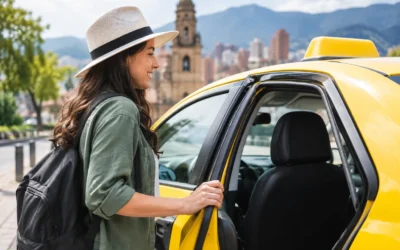
Use licensed taxis arranged through your hotel or a recognized app where available. In major cities, do not hail a cab from a quiet street late at night. For airport arrivals, know your transfer plan before you land, especially if your flight reaches Bogota or Medellin after dark.
Carry what you need for the day rather than every bank card, document, and device you own. Keep a backup card separately, use ATMs inside banks or malls when possible, and avoid displaying a phone at the edge of a busy street. Locals commonly practice a form of low-profile awareness sometimes described as “no dar papaya” – do not make yourself an easy target. It is not about blaming victims; it is about recognizing that visible valuables create opportunity.
Travel during daylight when you can, but do not turn that into an inflexible rule. Domestic flights, a pre-booked airport transfer, and a well-known intercity bus are different situations from taking an unplanned rural road after sunset. Consider the route, the operator, weather, and current local advice rather than relying on one blanket standard.
Situations that deserve extra caution
The following scenarios are worth treating more carefully because they create a mismatch between what an independent traveler expects and what conditions may actually be like:
- Hiking or visiting waterfalls in isolated areas without confirming local access, weather, and guide requirements.
- Traveling by road through a remote department simply because it is cheaper than flying.
- Joining a protest, lingering near demonstrations, or assuming a peaceful gathering will remain predictable.
- Accepting drinks, rides, or invitations from strangers after a night out.
- Using unofficial money changers, taxis, border crossings, or tour providers to save a small amount.
This is not a case for traveling nervously. It is a case for choosing established services where the downside of improvising is high.
Health, protests, and practical disruptions
Security is only one part of an advisory-minded trip. Colombia’s geography creates its own practical risks. Altitude can affect travelers in Bogota and mountain destinations, while heat and dehydration are more likely on the Caribbean coast. Mosquito-borne illness precautions may be relevant in lower-altitude tropical areas, depending on your route and the season.
Demonstrations and road closures can disrupt plans even when tourists are not the target. In cities, avoid protest areas and leave if crowds begin to build. On longer routes, keep some flexibility in your itinerary. Booking every connection tightly can turn a delayed bus or domestic flight into an expensive chain reaction.
Travel insurance is particularly useful in Colombia when it includes medical treatment, evacuation, and interruption coverage. Read the policy rather than assuming every activity is covered. Motorcycle use, scuba diving, trekking at altitude, and travel to areas subject to official restrictions may come with exclusions.
A better way to use official advice
Use official advisories as one input, then compare them with your exact plan. Ask practical questions: Are you staying in well-reviewed accommodations? Is your transport daytime and pre-arranged? Are you visiting a named restricted area? Do you have enough time to avoid rushed late-night transfers? Can you change course if local conditions shift?
Colombia is not a destination to approach carelessly, but neither is it a country that can be understood through one warning level. Plan the route you actually want to take, leave the genuinely high-risk areas off the map, and give yourself enough margin to travel with calm, curiosity, and good judgment.

0 Comments