
A flight between Bogotá and Medellín takes barely an hour, yet the change in landscape, temperature, food, and rhythm can feel like crossing several countries. That contrast is the best starting point for answering what makes colombia different from other latin american countries? Colombia is not one easily packaged travel experience. It is a country of sharp geographic shifts, intensely regional identities, unusually green landscapes, and cities that reward travelers who plan with flexibility.
For an independent trip, that diversity is both the appeal and the practical challenge. You can have Caribbean heat in Cartagena, cool mountain air in Bogotá, coffee-country hills near Salento, and jungle conditions around Leticia – often within one itinerary. The key is not to treat Colombia as a smaller version of its neighbors, but to understand the particular mix that shapes travel here.
Colombia’s geography changes the way you travel
Colombia is the only country in South America with coastlines on both the Caribbean Sea and the Pacific Ocean. That fact matters, but the Andes matter even more. Instead of one continuous mountain spine, the Andes split into three major ranges as they run through the country. Between them lie deep valleys, high plateaus, rivers, farmland, and cities built at very different elevations.
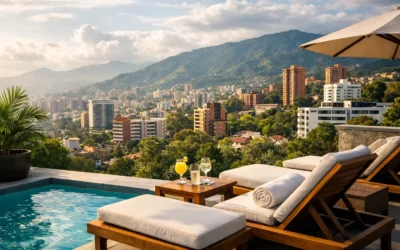
This creates a level of variety that can surprise first-time visitors. Bogotá sits high in the Andes at roughly 8,660 feet, where a jacket is useful year-round. Medellín has a mild spring-like climate, while Cartagena is hot and humid almost every day. In the coffee region, rain can arrive quickly even after a bright morning.
Many Latin American countries offer dramatic geography, of course. Peru has the Andes and coast, Mexico has deserts and beaches, and Brazil has enormous ecological range. Colombia feels distinctive because such different environments are relatively close together, but overland travel between them can still be slow. Mountains, winding roads, weather, and traffic mean a short distance on a map does not always mean an easy transfer.
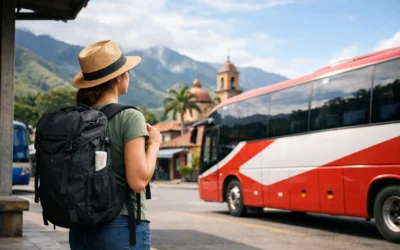
For travelers, this is a reason to build in breathing room. Flying is often the sensible choice between major regions, while buses work well when the route itself is part of the experience. A Colombia itinerary becomes more enjoyable when you choose fewer regions and spend longer in each one.
Regional identity is stronger than many visitors expect
Colombia is united by Spanish, national symbols, and a strong sense of pride, but it is not culturally uniform. People from the Caribbean coast, Antioquia, Bogotá, the coffee axis, Cali, and the Pacific region often have distinct accents, expressions, foods, music, and ways of relating to visitors.
In Medellín and much of Antioquia, you will hear the paisa accent and notice a direct, sociable style of hospitality. Cali is closely connected to salsa, with nightlife and dance woven into the city’s identity. Bogotá can feel more reserved and fast-paced, shaped by its size, altitude, and role as the national capital. Along the Caribbean coast, daily life generally moves at a different tempo, and African, Indigenous, and Caribbean influences are especially visible in music and cuisine.
This is not unique to Colombia – regionalism exists throughout Latin America – but Colombia’s topography has helped preserve these differences. Mountain barriers historically kept regions more separated than they appear today on a map. As a visitor, that means it is worth adjusting expectations from place to place rather than assuming one city represents the whole country.
Spanish is familiar, but Colombian Spanish has its own character
Travelers with some Spanish often find Colombia approachable, particularly in cities where people are used to international visitors. Yet vocabulary and formality can differ by region. Colombians are widely known for using courteous language, including frequent use of usted, even among people who would use the more informal tú elsewhere.
You do not need to speak perfect Spanish to travel independently, but a few practical phrases and a patient attitude go a long way. The warmth many visitors experience is real, though it should never be mistaken for an obligation to accept every invitation, taxi offer, or sales pitch without judgment.
What makes Colombia different from other Latin American countries for travelers?
One of Colombia’s defining travel qualities is the concentration of major cities within a landscape that remains visibly rural and wild. Bogotá, Medellín, Cali, Barranquilla, and Cartagena each have their own role and personality. Yet it is often possible to move from an urban neighborhood of museums, restaurants, and cafés to coffee farms, cloud forest, colonial towns, or national parks in a matter of hours.
Medellín especially draws attention because of its transformation. The city has invested heavily in public transportation, libraries, public spaces, and hillside connections, including the cable car system. Its story is meaningful, but travelers should avoid reducing Medellín to a before-and-after narrative centered only on Pablo Escobar. It is a large, creative, complicated city where design, entrepreneurship, nightlife, inequality, and everyday neighborhood life all exist at once.
Bogotá offers a different experience: ambitious dining, excellent museums, cycling culture, and a huge urban population spread across a high-altitude basin. Cartagena is visually immediate, with colonial walls and Caribbean color, but it can also be more expensive, hotter, and more tourism-driven than other parts of the country. Each destination has trade-offs, which is exactly why a one-size-fits-all Colombia trip rarely works.
Biodiversity is not just a statistic here
Colombia is regularly recognized as one of the world’s most biodiverse countries. For travelers, that becomes tangible quickly. Hummingbirds appear in mountain gardens. Howler monkeys can be heard near the Caribbean coast. The Pacific attracts whale-watchers during the season, while the Amazon opens a completely different world of river travel, Indigenous communities, and rainforest ecology.
The country’s birdlife is especially remarkable. You do not need to be a serious birder to notice it, but birdwatchers can easily build a full trip around Colombia. The same applies to hiking, diving, wildlife photography, and nature-focused stays.
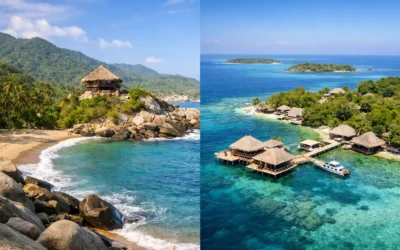
Still, biodiversity does not mean every natural destination is simple to reach. Some of Colombia’s most rewarding areas require domestic flights, boats, guides, advance permits, or comfort with basic infrastructure. Tayrona National Park, the Pacific coast, the Amazon, and remote mountain areas can be unforgettable, but they demand more preparation than a city break in Bogotá or Medellín.
Food is regional, filling, and more varied than its reputation
Colombian food is sometimes unfairly described as mild or repetitive by travelers who only try a few familiar dishes. The better approach is to eat region by region. On the Caribbean coast, look for fried fish, coconut rice, arepas de huevo, patacones, and fresh fruit. In Antioquia, bandeja paisa is the famous substantial plate, while Bogotá is known for ajiaco, a comforting chicken and potato soup. In the coffee region, simple farm-style meals often highlight local produce, trout, plantains, and excellent coffee.
Colombia’s fruit culture also stands out. Markets and juice stands introduce travelers to lulo, guanábana, maracuyá, guayaba, borojó, and many fruits that are rarely seen fresh in the United States or Europe. Ask what is in season and try juices made with water or milk, depending on the fruit and your preference.
The country’s coffee reputation deserves attention too, but not every cup will automatically be exceptional. Much of Colombia’s best coffee has historically been exported, and quality varies. Seek out specialty coffee shops in major cities or visit a well-run farm in the coffee region if you want to understand the process beyond the souvenir bag.
The country’s recent history requires a more thoughtful lens
Colombia’s international image was shaped for decades by armed conflict, drug trafficking, and the violence associated with cartels and guerrilla groups. That history is real and continues to affect communities differently across the country. But it is not the whole story, nor is it a tourist theme park.
Security has improved dramatically in many destinations, allowing independent travelers to visit places that were once far harder to access. At the same time, Colombia is not a place to switch off common sense. Petty theft, phone snatching, scams, and risks linked to nightlife occur in major cities, as they do across the region. Some rural and border areas remain unsuitable for casual travel because conditions can change.
A practical approach is better than fear or false confidence. Use registered transport when arriving late, keep your phone out of sight in busy streets, avoid isolated areas after dark, and ask locally about neighborhoods and current conditions. The common Colombian phrase no dar papaya roughly means not making yourself an easy target. It is useful travel advice, not a reason to avoid the country.
Plan for variety, not a checklist
Colombia works best when your route has a clear rhythm. A first trip might combine Bogotá, Medellín, and the coffee region, or Bogotá with Cartagena and a quieter Caribbean stop. Travelers with more time can add Cali, the Pacific, the Amazon, Villa de Leyva, Mompox, San Andrés, or remote trekking areas.
Trying to see every famous place in two weeks usually means too many airport transfers and too little time to understand each region. Choose based on your interests: cities and food, hiking and nature, beaches and diving, dance and music, or a combination of two or three. Colombia My Way’s approach is simple: plan independently, but let travel times and regional differences shape the itinerary.
The country’s real distinction is not a single landmark, dish, or stereotype. It is the feeling that every change of altitude brings a new version of Colombia. Leave space in your plan for that surprise, and you will travel with more freedom and far less rush.

0 Comments